




Overview of Languages in Nepal
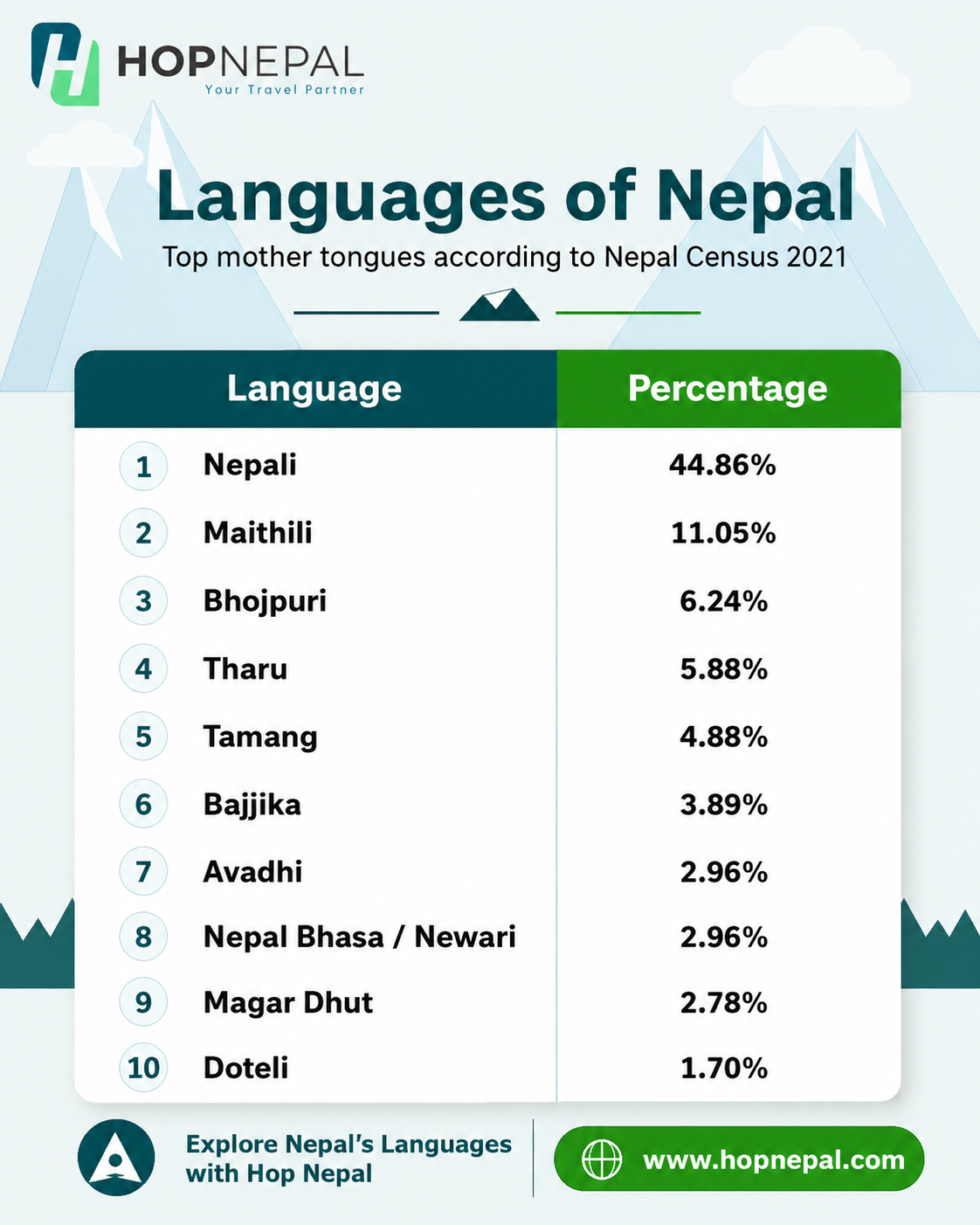
Nepal has 124 mother tongues, according to the 2021 National Population and Housing Census. Nepali is the official language and the most widely spoken mother tongue, followed by Maithili, Bhojpuri, Tharu, Tamang, Bajjika, Avadhi, Nepal Bhasa/Newari, Magar Dhut, and Doteli.
For a small Himalayan country, Nepal’s cultural and linguistic diversity is truly remarkable. The country is home to 142 caste and ethnic groups, each with its own traditions, identity, lifestyle, and in many cases, language.
Although Nepali is widely understood across the country, Nepal is far from being a single-language nation. Different communities speak different mother tongues depending on their region, ethnicity, and cultural background. This is one of the reasons travelling across Nepal feels so rich and varied. From the Terai plains to the hills and Himalayan settlements, language changes with geography, community, and local culture.
Nepali is spoken as a mother tongue by around 44.86% of the population, making it the most widely spoken language in Nepal. Maithili comes second with around 11.05%, followed by Bhojpuri, Tharu, Tamang, Bajjika, Avadhi, Nepal Bhasa/Newari, Magar Dhut, and Doteli.
Many smaller languages are spoken by less than one per cent of the population. Some of these languages are still actively used in local communities, while others are at risk of disappearing. Below, we have explained the major languages spoken in Nepal to help travellers better understand the country’s people, culture, and everyday communication.
List of 10 Most Spoken Languages in Nepal
- Nepali – Official Language of Nepal
- Maithili
- Bhojpuri
- Tharu
- Tamang
- Bajjika
- Avadhi
- Nepal Bhasa / Newari
- Magar Dhut
- Doteli
1. Nepali – Official Language of Nepal
Understood and accepted by all, the Nepali is the official language of Nepal and the most widely understood language across the country. People called it 'Khas Kura' during ancient times. Since then, it has come a long way and taken its original form as Nepali. Taking its roots in the Sanskrit language, the Nepali language reflects the glorious history of Nepal in every letter. Despite its derivation from Sanskrit, Nepali is also influenced by Tibeto-Burman languages. Because of its popularity among the citizens, it also serves as the Official Language of Nepal.
Nepali is the most widely spoken mother tongue in Nepal, spoken by around 44.86% of the population. It is also the official language of Nepal and is widely used in government offices, schools, media, business, and everyday communication.
2. Maithili
The Maithili language is Nepal's second most spoken language, mainly in the Terai region of Nepal. The name of the Maithili language derives from the Mithila region of Nepal, known for its rich ancient culture. The significant demographics of this language live in the southeastern Terai of Nepal. Maithili is widely spoken in Nepal’s eastern and central Terai, especially in districts such as Dhanusha, Mahottari, Siraha, Saptari, Sarlahi, and nearby areas. It is also widely spoken in parts of India, such as Bihar, Jharkhand, and West Bengal. Maithili is spoken by around 11.05% of Nepal’s population and is the second most spoken mother tongue in the country.
3. Bhojpuri
Bhojpuri is spoken by around 6.24% of Nepal’s population and is the third most spoken mother tongue in the country. It is mainly used in the southern Terai region, including districts such as Chitwan, Rupandehi, Nawalparasi, Bara, Parsa, and Rautahat. Some districts with the largest Bhojpuri-speaking populations are Chitwan, Rupandehi, Nawalparasi, Bara, Parsa, and Rautahat. It is also one of the major languages spoken in parts of India.
4. Tharu
Tharu is spoken by around 5.88% of the population and is one of the most important indigenous languages of Nepal. Tharu language holds great importance among the Nepalese languages. It is widely spoken in districts such as Kailali, Dang, Bardiya, Surkhet, Saptari, Bara, Parsa, Rautahat, and other Terai areas. Different Tharu communities also speak different varieties of the language. Moreover, different variants of this language are also spoken in different parts.
5. Tamang
Tamang is spoken by around 4.88% of Nepal’s population and is widely used by Tamang communities in the central hill regions. The Tamang language has several variants that hold an essential place among Nepalese languages. Five different dialects of Tamang are the major variants of this language: Eastern Tamang, Eastern Gorkha Tamang, Western Tamang, North-western Tamang, and South-western Tamang. The language is spoken in places like Sindhupalchowk, Rasuwa, Makwanpur, Lalitpur, Dhading, Chitwan, Nuwakot, Dolakha and Kavrepalanchok.
6. Bajjika
Bajjika is spoken by around 3.89% of Nepal’s population and is one of the major languages of the Terai region. It is mainly spoken in districts such as Sarlahi, Rautahat, Mahottari, and nearby areas. The language shares close cultural and linguistic connections with Maithili and Bhojpuri.
7. Avadhi
Avadhi is one of the major languages spoken in Nepal, especially in the western Terai region. It is spoken by about 2.96% of the population and is closely connected to the culture, songs, stories, and daily life of many communities living near the Nepal-India border.
8. Nepal Bhasa / Newari
Nepal Bhasa, also known as Newari, is mainly spoken by Newar communities, especially in the Kathmandu Valley. Around 2.96% of Nepal’s population speaks Nepal Bhasa as a mother tongue. The language holds great cultural importance because of its deep connection with the history, festivals, art, trade, and traditional lifestyle of the Newar community.
9. Magar Dhut
Magar Dhut is spoken by around 2.78% of Nepal’s population and is the mother tongue of many Magar communities. It is mainly used in the hills of western, mid-western, and eastern Nepal. Different Magar communities also speak related varieties such as Kham Magar, Tarali, and Kaike in different regions.
10. Doteli
Doteli is spoken by around 1.70% of Nepal’s population, mainly in the far-western region. It is commonly used in districts such as Doti, Dadeldhura, Baitadi, Bajhang, Bajura, and Darchula. Doteli has a strong connection with the culture, folk songs, stories, and daily life of far-western Nepal.
Other important languages spoken in Nepal include Urdu, Limbu, Gurung, Rai, Sherpa, Hindi, Chepang, and many other local mother tongues. Urdu is mainly spoken by Muslim communities, especially in parts of the Terai region.
Some Other Languages of Nepal:
- Limbu
- Gurung
- Rai
- Sherpa
- Hindi
- Chepang
- Urdu
Nepal’s linguistic heritage mainly comes from Indo-Aryan and Tibeto-Burman language families, along with smaller indigenous and local language groups. This mix of languages reflects Nepal’s long history of migration, settlement, trade, religion, and cultural exchange.
Many smaller languages in Nepal are still used in local communities, but some are slowly becoming less common, especially among younger generations. As Nepali and English become more widely used in education, media, and work, several local mother tongues face the risk of decline. Preserving these languages is important because they carry the stories, traditions, songs, and identity of Nepal’s diverse communities. Nepal’s wide variety of languages represents the country’s rich culture and heritage. Protecting these languages is important for preserving the identity of Nepal’s many communities.
Do People Speak English in Nepal?
English is widely used in Nepal’s tourism industry, especially in cities like Kathmandu, Pokhara, and Chitwan, as well as in major trekking regions. Many guides, hotel staff, travel agencies, restaurants, and transport operators can communicate in English, so travellers usually do not face major language problems during their trip.
In rural areas, English may not be widely spoken, but basic communication is usually possible with the help of guides, locals, or simple Nepali phrases. Learning a few Nepali words like “Namaste,” “Dhanyabad,” and “Kati ho?” can make your travel experience warmer and more personal.
FAQs About Languages in Nepal
1. How many languages are spoken in Nepal?
Nepal has 124 mother tongues, according to the 2021 National Population and Housing Census. These languages reflect the country’s rich ethnic, cultural, and regional diversity.
2. What is the official language of Nepal?
The official language of Nepal is Nepali. It is widely used in government offices, schools, media, business, and daily communication across the country.
3. What is the most spoken language in Nepal?
Nepali is the most spoken mother tongue in Nepal. Around 44.86% of Nepal’s population speaks Nepali as their mother tongue.
4. What are the top 10 languages spoken in Nepal?
The top 10 most spoken mother tongues in Nepal are Nepali, Maithili, Bhojpuri, Tharu, Tamang, Bajjika, Avadhi, Nepal Bhasa/Newari, Magar Dhut, and Doteli.
5. Is Maithili spoken in Nepal?
Yes, Maithili is the second most spoken mother tongue in Nepal. It is mainly spoken in the Terai region, especially in districts such as Dhanusha, Mahottari, Siraha, Saptari, Sarlahi, and nearby areas.
6. Do people speak English in Nepal?
Yes, English is commonly used in Nepal’s tourism industry, especially in Kathmandu, Pokhara, Chitwan, and major trekking areas. Guides, hotel staff, travel agencies, and restaurants in tourist areas usually communicate in English.
7. What language is spoken in Kathmandu?
In Kathmandu, people commonly speak Nepali. Nepal Bhasa/Newari is also an important local language of the Newar community, especially in the Kathmandu Valley.
8. Is Nepali similar to Hindi?
Nepali and Hindi both use the Devanagari script and share some Sanskrit-based words, so they may look similar in writing. However, they are different languages with different pronunciation, grammar, and everyday usage.
9. Which language do tourists need to know in Nepal?
Tourists do not need to know Nepali to travel in Nepal, especially in popular tourist areas. However, learning simple words like Namaste, Dhanyabad, and Kati ho? can make communication with locals warmer and easier.
10. Why does Nepal have so many languages?
Nepal has many languages because it is home to diverse ethnic groups, cultures, landscapes, and communities. Different languages developed across the mountains, hills, valleys, and Terai regions over many generations.
11. Are all languages in Nepal still spoken today?
Many languages in Nepal are still spoken in local communities. However, some smaller mother tongues are at risk as younger generations increasingly use Nepali, English, or other widely spoken languages.
12. Why are languages important in Nepal’s culture?
Languages in Nepal are closely connected with identity, festivals, songs, stories, rituals, and community traditions. They are an important part of Nepal’s cultural heritage and help preserve the history of different ethnic groups.


