



Overview
Trip Overview
Book Your 15-Day Manaslu Circuit Trek
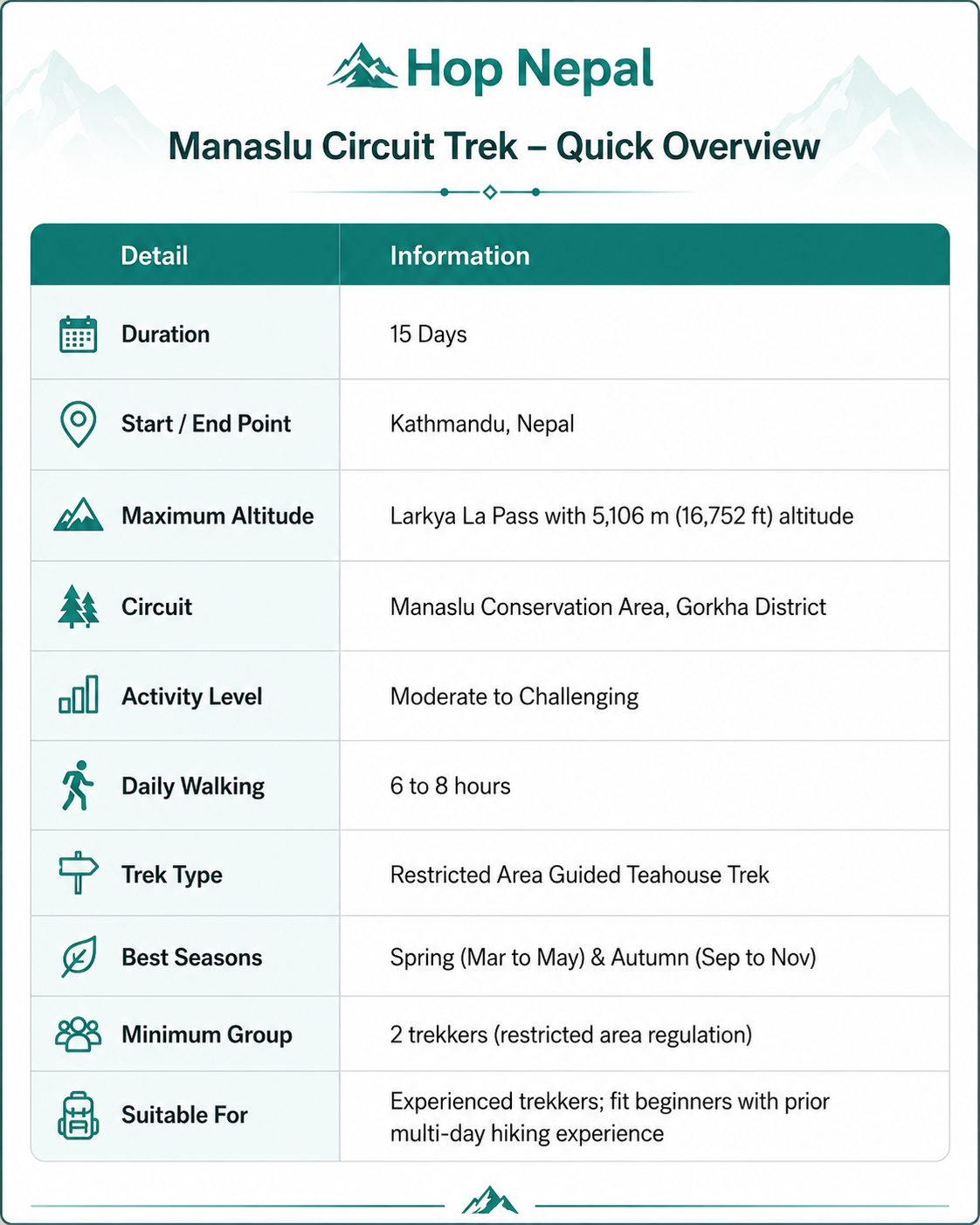
The 15-day Manaslu Circuit Trek is widely regarded by experienced Himalayan trekkers as one of Nepal's finest and most complete trekking adventures, combining dramatic high-altitude mountain scenery, ancient Tibetan Buddhist culture, extraordinary biodiversity, and the raw, unspoiled remoteness that has largely disappeared from more commercialised trekking routes. This is the trek that delivers what the Everest and Annapurna regions once offered before mass tourism arrived: genuine wilderness, authentic village encounters, and the profound sense that you are somewhere truly few people ever reach.
The route circumnavigates Mount Manaslu (8,163 m), the eighth-highest mountain on Earth and one of the most technically demanding of the fourteen 8,000-metre peaks within the protected boundaries of the Manaslu Conservation Area. From the subtropical river gorges of the lower Budhi Gandaki valley to the wind-scoured alpine plateau of the Larkya La Pass (5,106 m), the highest and most dramatic point of the entire circuit, the 15-day itinerary passes through an astonishing spectrum of Himalayan landscapes, cultures, and ecosystems within a single continuous journey.
Because the Manaslu region is a restricted trekking area requiring special government permits and a licensed guide, the trail remains significantly less crowded than the Everest and Annapurna routes, even during peak trekking seasons. This restriction is, paradoxically, the trek's greatest asset: it preserves the authenticity, cultural integrity, and raw natural beauty that make the Manaslu Circuit genuinely extraordinary.
The 15-day itinerary is carefully constructed to manage altitude gain safely, provide adequate acclimatisation before the Larkya La crossing, allow meaningful cultural engagement in the remarkable Tibetan-influenced villages of Samagaon and Samdo, and deliver the full, uncompromised Manaslu Circuit experience without unnecessary rushing.
TOP TREK MOMENTS
Highlights
- Scenic overland drive from Kathmandu through rural Nepal to the trailhead at Soti Khola, a journey through terraced hillsides, river valleys, and traditional Gurung and Magar communities
- The Budhi Gandaki River gorge is one of Nepal's deepest and most spectacular river canyons, crossed by a series of thrilling high suspension bridges.
- Immerse yourself in the extraordinary Tibetan Buddhist villages of Samagaon and Samdo. In these ancient, high-altitude settlements, Tibetan culture, architecture, and spirituality have been preserved in near-original form for centuries.
- An optional acclimatisation hike to Manaslu Base Camp offers an extraordinarily close perspective on the sheer, glaciated south face of the world's eighth-highest mountain.
- Cross the legendary Larkya La Pass (5,106 m), which is the defining physical and emotional centrepiece of the entire circuit, with panoramic views of Manaslu, Himalchuli, Ngadi Chuli, and the vast Tibetan plateau to the north.
- Experience the remarkable transition from subtropical forest to high alpine terrain within a single multi-day journey, one of the most dramatic ecological gradients of any trekking route in Nepal
- Trek through pristine, uncrowded wilderness that feels genuinely remote and untouched compared to the busier Everest and Annapurna corridors
- Visit ancient mani walls, prayer wheel corridors, and monastery complexes that reflect the deep Tibetan Buddhist spiritual heritage of the Manaslu region.
- Spectacular close-up views of Manaslu (8,163 m), Himalchuli (7,893 m), Ngadi Chuli (Peak 29, 7,871 m), and the Ganesh Himal range throughout the circuit
DAY BY DAY
Detailed Itinerary
Day 1
Day 2
Day 3
Day 4
Day 5
Day 6
Day 7
Day 8
Day 9
Day 10
Day 11
Day 12
Day 13
Day 14
Day 15
ROUTE VISUAL
Google Map
ELEVATION PROFILE
Altitude Map
Highest point: Dharamsala to Larkya La Pass to Bimthang (5106 m)
WHAT'S INCLUDED
Detailed Inclusions
- Airport pickup and drop-off in Kathmandu (domestic and international terminals)
- 3-star hotel accommodation in Kathmandu
- Teahouse/lodge accommodation throughout the trek (twin sharing, all nights)
- Full board meals during the trek
- All required restricted area permits
- Government-licensed, experienced English-speaking trekking guide (mandatory for restricted area)
- Experienced, trained porter service (1 porter per 2 trekkers; carrying up to 20 to 25 kg)
- Guide and porter wages, insurance, food, and accommodation throughout
- Ground transportation
- Group first-aid kit, pulse oximeter, and emergency support preparations
- All applicable government taxes and service charges
WHAT'S EXCLUDED
Detailed Exclusions
- International flights to and from Kathmandu
- Nepal tourist visa fees (approximately USD $30 for 15 days / $50 for 30 days)
- Travel insurance with high-altitude trekking and helicopter evacuation coverage (mandatory)
- Extra meals in Kathmandu beyond bed & breakfast
- Personal trekking gear and equipment (boots, clothing, sleeping bag, trekking poles)
- Personal expenses on trek
- Tips for guide and porter (customary and strongly encouraged)
- Any costs arising from weather delays, route changes, trip extensions, or emergency evacuations not covered by insurance.
ESSENTIAL TREK INFO
Good to Know
Required Permits
The Manaslu Circuit Trek is a restricted trekking area, one of a small number of regions in Nepal that require special government permits in addition to the standard conservation area fees. This restriction is what keeps the Manaslu trail genuinely uncrowded and its cultural and natural environments authentically preserved. Your operator obtains all three required permits on your behalf.
Manaslu Restricted Area Permit (RAP)
The most important and distinctive permit for the Manaslu Circuit. Issued by the Government of Nepal's Department of Immigration, this permit restricts access to the Manaslu region to trekkers travelling with a licensed guide in groups of at least two people. The fee structure changes by season:
- September to November (Autumn Peak): USD $100 per person for the first 7 days + USD $15 per additional day
- December to August (Off-Peak): USD $75 per person for the first 7 days + USD $10 per additional day
This permit is checked at multiple checkpoints throughout the circuit, beginning at Jagat.
Manaslu Conservation Area Permit (MCAP)
This permit covers entry to the Manaslu Conservation Area established in 1998 to protect the extraordinary biodiversity and cultural heritage of the Manaslu region. Fee: NPR 3,000 (approximately USD $23 to $25) per person. Checked at the Soti Khola entry point and subsequent checkpoints.
Annapurna Conservation Area Permit (ACAP)
The final section of the Manaslu Circuit from Bimthang to Dharapani passes through the Annapurna Conservation Area. Fee: NPR 3,000 (approximately USD $23 to $25) per person. This permit is verified at the Dharapani checkpoint on the final day of trekking.
Mandatory Guide Requirement
Unlike most trekking routes in Nepal, the Manaslu Circuit legally requires a licensed guide. Independent trekking is not permitted in the restricted area. Groups must consist of at least two trekkers. These regulations are strictly enforced at permit checkpoints throughout the route.
Altitude Acclimatisation Strategy
The Manaslu Circuit's maximum altitude of 5,106 m (Larkya La Pass) places it firmly in the high-altitude trekking category comparable to the upper sections of the EBC route. Careful altitude management is non-negotiable for a safe and successful crossing of the Larkya La.
Altitude Gain Profile
The 15-day itinerary is structured to provide a gradual, physiologically sound ascent profile. From Soti Khola (710 m) to Larkya La (5,106 m), the sleeping altitude never increases by more than 600-800 m per day above 2,500 m, within the parameters recommended by altitude medicine authorities.
The Samagaon Acclimatisation Day
The acclimatisation day at Samagaon (3,530 m) on Day 8, including the optional hike to Manaslu Base Camp (4,800 m), is the most critical single day for AMS prevention on the entire circuit. By ascending to 4,800 m and returning to sleep at 3,530 m, trekkers deliver a powerful physiological acclimatisation stimulus that prepares the body for the transition to 4,460 m (Dharamsala) and 5,106 m (Larkya La) in subsequent days. This day is non-negotiable in a responsible itinerary.
Larkya La Pass: Altitude Awareness
The Larkya La at 5,106 m is the highest point of the circuit and carries genuine altitude risk. Pre-existing AMS at Dharamsala (4,460 m) is an absolute contraindication to attempting the pass; descend immediately if symptoms are present. On the day of the pass, start early, pace conservatively, eat and drink before departure, and carry emergency Diamox and supplemental snacks. Your guide carries emergency oxygen and a satellite communication device for emergencies on the pass.
General Guidelines
- Hydrate consistently: 3 to 4 litres per day throughout the circuit
- Eat regularly even when appetite is reduced above 3,500 m
- Never ascend if experiencing a persistent headache, nausea, or dizziness; rest and inform your guide.
- Descend immediately and without debate if moderate to severe AMS symptoms develop.
- The only effective treatment for worsening AMS is descent; there is no substitute.
Best Time to Trek the Manaslu Circuit
Spring: March to May (Peak Season)
Spring delivers stable weather windows, warming temperatures, clear morning skies, and the spectacular rhododendron bloom that transforms the lower and middle sections of the circuit into a sea of pink and red blossoms. April is the prime spring month; conditions are generally settled, temperatures at altitude are manageable, and the trail has a joyful, international energy. The Larkya La is typically free of deep snow from late March onward. Book significantly in advance; spring is the busiest season, and restricted-area permits are in higher demand.
Autumn: September to November (Best Overall)
The post-monsoon autumn season offers the finest overall conditions for the Manaslu Circuit. From late September, the monsoon clears, the Himalayan air becomes extraordinarily clean, mountain visibility is at its annual peak, and the deep blue skies of October showcase the entire Manaslu massif in breathtaking clarity. October is universally the best single month for the Manaslu Circuit. November extends excellent conditions but brings colder temperatures at altitude and the first possibility of early winter snowfall on the Larkya La.
Winter: December to February
Winter trekking on the Manaslu Circuit is possible but requires serious preparation. The Larkya La Pass may be blocked by deep snow, making the crossing dangerous or impossible for standard trekkers without mountaineering experience. Temperatures at Dharamsala and Samdo can drop to -20°C or below at night. Some teahouses above Samagaon close in deep winter. Recommended only for experienced cold-weather trekkers with comprehensive gear and a flexible schedule.
Monsoon: June to August
The summer monsoon brings heavy rainfall throughout the Budhi Gandaki valley, a significant landslide risk in the lower gorge sections, persistent cloud cover, and very difficult trail conditions. The Manaslu Conservation Area receives substantial monsoon precipitation. Not recommended for most trekkers. The upper sections of the circuit above Samagaon are in a partial rain shadow, but access through the lower gorge remains challenging.
Difficulty Level & Fitness Requirements
Rating: Moderate to Challenging
The Manaslu Circuit Trek is rated a step above the Annapurna Base Camp route and comparable in difficulty to the upper sections of the EBC trek. The combination of high daily walking hours (6 to 8 hours), significant altitude gain (maximum 5,106 m), remote, less-serviced trail conditions, the physical and psychological demands of the Larkya La Pass day, and 13 consecutive trekking days makes this a genuinely challenging undertaking that requires solid preparation.
No technical climbing skills, ropes, or mountaineering equipment are required. The route is a trekking path throughout, though demanding in the upper sections near and above 4,000 m.
Who Is the Manaslu Circuit Suitable For?
The Manaslu Circuit is ideal for: experienced trekkers seeking a less-crowded, more authentic Himalayan experience; trekkers who have completed a moderate-difficulty route (such as ABC or a similar multi-day mountain trek) and are ready to step up in commitment and altitude; and well-prepared fit beginners with a solid pre-trek training programme and realistic expectations.
Recommended Pre-Trek Training Programme
Begin at least 3 to 4 months before departure:
Cardiovascular Endurance:
The 6- to 8-hour daily walking demands of the Manaslu Circuit require a strong aerobic base. Sustained cardio training (hiking, running, cycling, swimming) 4 to 5 times per week, building session length progressively to 90 to 120 minutes. The ability to sustain effort over a full 9- to 10-hour day (Larkya La day) is the benchmark to train toward.
Leg Strength and Endurance:
The steep descents on the Larkya La crossing day are among the most physically demanding of any trekking route in Nepal. Squats, lunges, deadlifts, and stair climbing with a loaded pack are essential. Eccentric leg training, the muscle action used when descending steep terrain, is particularly important and often neglected.
Multi-Day Loaded Hiking:
Nothing substitutes for actual multi-day hiking with a loaded pack on real terrain. Include at least two or three multi-day weekend hikes with a fully loaded daypack in the final 6 to 8 weeks before departure.
High-Altitude Exposure (if possible):
If you have access to high-altitude terrain (above 3,000 m), training hikes or climbs at altitude are enormously beneficial for understanding your body's specific response to reduced oxygen.
Complete Packing List
Clothing & Footwear
- Waterproof, ankle-supporting trekking boots are the most important single piece of gear. Break them in thoroughly. The Manaslu trail includes extended sections of rocky, uneven terrain where inadequate footwear becomes a safety issue.
- Trekking sandals or camp shoes for teahouse evenings
- 6 to 8 pairs merino wool trekking socks, moisture-wicking, warm, and blister-resistant
- Moisture-wicking base-layer tops (3 to 4, synthetic or merino wool)
- Thermal base-layer leggings essential from Namrung upward
- Convertible trekking trousers
- Fleece mid-layer jacket (200 weight or heavier for the upper circuit)
- A down jacket rated to -15°C is required. The Larkya La at pre-dawn in October can drop to -15°C or colder; this is the most critical single clothing item.
- Waterproof, windproof shell jacket; the lower gorge sections receive rain even outside monsoon; the upper circuit is exposed to wind
- Insulated down trousers for the Larkya La crossing day and Dharamsala night
- Warm hat covering the ears fully.
- Balaclava essential for the pre-dawn Larkya La ascent
- Fleece inner gloves and waterproof, insulated outer mittens
- High-UV sunglasses (CE Category 4) and glacier goggles; snow glare on the Larkya La is extreme.
- Trekking gaiters for snow sections on the Larkya La approach and crossing
Pack & Sleep
- 35 to 45 litre daypack for daily use
- 80-litre lockable duffel bag for porter carry
- Sleeping bag rated to -20°C: Dharamsala and the upper circuit nights are genuinely extreme; this is not a place to economise on sleeping bag rating.
- Compression dry sacks and waterproof pack liners
- Adjustable, collapsible trekking poles: essential for the Larkya La descent; non-negotiable on this route
Health & Safety
- Personal first-aid kit: blister plasters, moleskin, paracetamol, ibuprofen, Imodium, antihistamines, antiseptic, bandages, rehydration sachets
- Pulse oximeter: daily SpO2 monitoring is a critical safety practice above 3,500 m on this remote route
- Water purification tablets or UV SteriPen + 2x 1-litre reusable water bottles
- Sunscreen SPF 50+ and UV lip balm
- Diamox (Acetazolamide): prescription required; carry as both prophylactic and emergency treatment
- Dexamethasone prescription required; emergency AMS treatment carried by guide
- Electrolyte sachets
- Blister prevention (Body Glide or petroleum jelly for high-mileage day protection)
Electronics & Documents
- Headlamp with fresh batteries and backup batteries the 3:00 AM Larkya La departure makes this non-negotiable
- High-capacity power bank (20,000 mAh minimum; charging is unreliable above Samagaon)
- Universal travel adaptor
- Camera or smartphone with ample memory and storage
- Offline maps downloaded (Maps.me or Gaia GPS, the Manaslu circuit is well-mapped offline)
- Satellite communicator (Garmin inReach highly recommended given route remoteness)
- Passport, Nepal visa, travel insurance documents, permit copies (physical originals)
- USD cash and Nepali rupees (last reliable ATM is in Arughat or Besisahar, withdraw before the trek)
Travel Insurance
Travel insurance is mandatory for the Manaslu Circuit Trek and is taken more seriously here than on almost any other Nepali trekking route. The remoteness of the Manaslu valley means that in a medical emergency, helicopter evacuation is the only viable evacuation option from most points on the circuit and without insurance, this cost falls entirely on you or your family.
Minimum Coverage Requirements
- High-altitude trekking coverage explicitly stated up to at least 6,000 m (the Larkya La sits at 5,106 m; a substantial buffer above this is essential)
- Helicopter evacuation and emergency rescue absolutely the most critical coverage element for this route
- Medical expenses including hospitalisation in Nepal and medevac to your home country
- Trip cancellation and delay coverage: road washouts and weather events can significantly disrupt the Manaslu schedule.
- Baggage loss and personal liability
Helicopter Evacuation on the Manaslu Circuit
Emergency helicopter landing zones are located at several points on the circuit, including Samagaon, Samdo, and Bimthang. However, high winds, cloud, and weather can delay evacuation helicopters. Your guide carries a satellite communication device for emergency contact. Ensure your insurer's 24-hour international emergency number is saved on your phone and on a physical card carried in your daypack at all times.
Food & Accommodation
Teahouse Accommodation
The Manaslu Circuit's teahouse infrastructure is noticeably less developed than on the Everest or Annapurna routes, which is both a logistical reality and a significant part of the route's appeal. The relative simplicity of the teahouses reflects the region's genuine remoteness. Rooms are basic twin-sharing with wooden bed frames, thin mattresses, and blankets. You sleep in your own sleeping bag throughout. Shared bathrooms are standard above the lower valley. Attached bathrooms are available at lower-altitude stops (Jagat, Deng) but rare above Namrung.
The communal dining room, heated by a wood or yak-dung stove, is the essential social and warming hub of each teahouse. In villages like Samagaon and Samdo, the teahouse interiors themselves reflect Tibetan architectural aesthetics: low ceilings, thick stone walls, painted wooden beams, and Buddhist altar corners. The teahouse experience on the Manaslu Circuit carries an authenticity and intimacy that is increasingly rare on more commercial Himalayan routes.
Wi-Fi is available in lower villages (Jagat, Deng, Namrung) at an extra charge and is unreliable above Namrung. Device charging is available at most teahouses but increasingly dependent on solar power above Samagaon. Carry a fully charged, high-capacity power bank from Kathmandu.
Food on the Trek (Full Board Included)
- Dal Bhat: the definitive trekking fuel: lentil soup, steamed rice, seasonal vegetable curry, and pickle with unlimited refills—the most nutritionally complete, calorie-dense, and reliable option on any Nepali teahouse menu. Your guide and porters eat it daily; follow their lead.
- Tibetan bread: thick, pan-fried flatbread served with honey, jam, or butter. A warming, filling breakfast staple particularly popular in the upper Tibetan-influenced villages.
- Tsampa porridge: roasted barley flour porridge, the traditional Tibetan high-altitude breakfast. Sustaining, warming, and nutritionally excellent.
- Noodle and vegetable soups: thukpa (Tibetan noodle soup) and vegetable noodle soup are reliable, warming, and safe at all altitudes.
- Pasta, fried rice, and momos: widely available throughout the circuit.
- Eggs: fried, scrambled, or boiled, a consistent protein source at all teahouse stops.
- Hot drinks: sweet black tea, butter tea, ginger-lemon-honey tea, hot chocolate, and Nescafé. Maintaining fluid intake through hot drinks is essential on this cold, high-altitude route. Aim for 3 to 4 hot drinks per day above 3,000 m.
Important nutrition note: Above 3,500 m, appetite commonly decreases. Force yourself to eat consistently; your body is burning more calories than at sea level. On the Larkya La day, eat a full breakfast before departure regardless of how early or cold it is, and carry high-energy snacks (chocolate, nuts, energy bars, dried fruit) in your daypack pocket for continuous fueling throughout the crossing.
Guide & Porter Information
Guide is Mandatory and Essential
On the Manaslu Circuit, a licensed guide is not just recommended; it is legally required by government regulation. No trekker may enter the Manaslu Restricted Area without a licensed guide. This regulation exists for critically important safety reasons: the remoteness of the route, the complexity of permit checkpoints, the severity of the Larkya La crossing, and the limited emergency infrastructure in the upper valley all make a qualified guide not a luxury but a fundamental safety requirement.
Your guide is Government of Nepal licensed, altitude-awareness and wilderness first-aid trained, deeply experienced on the Manaslu Circuit, and carries group emergency equipment including a pulse oximeter, emergency oxygen, and a satellite communication device. They monitor your health daily, manage all permit checkpoints, coordinate with teahouse owners throughout the route, provide rich cultural interpretation of the Tibetan Buddhist villages and landscapes, and serve as your primary emergency response coordinator if a medical situation develops.
Porters
Porters on the Manaslu Circuit carry 20-25 kg of shared trekker luggage, slightly more than the standard EBC and ABC allocations, reflecting the longer daily stages and load requirements of this more remote route. Porters are typically local Gurung and Magar men from the Gorkha district, for whom trekking porter employment provides essential income.
Responsible Trekking in the Manaslu Conservation Area
The Manaslu Conservation Area is one of Nepal's most pristine and ecologically sensitive protected zones. The restricted permit system is in place partly to limit the environmental and cultural impact of trekking tourism; honour this intent through conscious, responsible trekking behaviour.
Environmental Practices:
- Carry a reusable water bottle and purification system throughout. Single-use plastic waste is a severe and growing problem in the Manaslu region; every plastic bottle you avoid purchasing makes a direct difference.
- Pack out all personal waste; do not leave litter at teahouses, on the trail, or at the Larkya La. The pass summit, in particular, should be left as clean as you find it.
- Stay on marked trails. The high-altitude terrain above Samagaon is extremely fragile; footsteps off the trail cause lasting damage to alpine vegetation and soil structure.
- Respect the cultural and archaeological sites along the route; mani walls, chortens, monastery buildings, and prayer wheels are living religious sites, not tourist infrastructure.
Cultural Practices:
- Walk clockwise around all mani walls, prayer wheels, and chortens; this is both respectful and universally observed by local communities.
- Remove hats and shoes before entering monastery buildings and prayer halls. Ask permission before photographing religious ceremonies or rituals.
- Engage with genuine curiosity and respect in the Tibetan villages of Samagaon and Samdo; these are real, living communities, not tourism displays. The warmth and generosity of the people you meet deserve reciprocal respect and genuine engagement.
- Learn a few Tibetan and Nepali phrases; even "Tashi Delek" (Tibetan greeting/good wishes) and "Namaste" express genuine respect and are received with real warmth.
Operator Responsibility:
- Choose a TAAN-registered, IPPG-compliant operator that genuinely supports local porter welfare, local guide employment, and community development in the Manaslu region.
- Spend money locally, purchase from village shops, eat at local teahouses, and prioritise Nepali-owned accommodations and services.
A Day on the Manaslu Circuit Trek
Understanding the daily rhythm of life on the Manaslu Circuit helps you set realistic expectations and pace yourself effectively across the 13 trekking days.
- 6:00 AM: Wake up. Dress in warm layers; mornings above 3,000 m are cold and dark. Begin packing your daypack with the day's essentials: water, snacks, extra layers, rain shell, headlamp, and first-aid items.
- 6:30 to 7:00 AM: Breakfast at the teahouse. Eat a full, carbohydrate-rich breakfast even if your appetite is limited. On Larkya La day, breakfast is served from 3:00 to 4:00 AM.
- 7:00 to 7:30 AM: Departure. Your guide sets the day's pace, typically a slow, steady rhythm that prioritises sustainability over speed. The Nepali trekking pace is deliberately conservative and is one of the primary reasons experienced guides get their clients to the destination safely.
- 10:00 to 11:00 AM: Mid-morning tea stop at a teahouse en route: sweet milk tea, biscuits, or a light snack. Rest for 15 to 20 minutes. Use your pulse oximeter to check your SpO2 if you are above 3,500 m.
- 12:00 to 1:00 PM: Lunch stop at a mid-route village. Hot soup, dal bhat, noodles, or pasta. A full 30 to 45-minute rest.
- 1:30 to 2:30 PM: Continue trekking toward the day's destination. The afternoon hours are often the warmest and most pleasant for walking.
- 3:00 to 4:00 PM: Arrive at destination teahouse. Check in, change into dry layers immediately, and begin rehydrating. Rest before dinner.
- 5:00 to 6:00 PM: Optional exploration of the village, monastery visit, or simply a warm communal dining room gathering with fellow trekkers. Your guide is an invaluable cultural resource during these evening hours.
- 6:30 to 7:00 PM: Dinner. Eat fully. The kitchen closes early in remote teahouses; don't delay.
- 8:00 to 9:00 PM: Early sleep. Consistent, quality sleep is one of the most important factors in altitude adaptation and daily physical recovery. The teahouse routine of early nights and early mornings is not a cultural quirk; it is a physiological necessity.
Internet & Connectivity
Wi-Fi
Wi-Fi is available in lower-altitude villages (Soti Khola, Machha Khola, Jagat, Deng) for an extra charge and with varying reliability. Above Namrung, connectivity is minimal and often non-existent at higher-altitude villages. Above Samagaon, do not rely on Wi-Fi for any communication needs. Prepare family and friends for a communication blackout during the upper circuit (approximately Days 7 to 12) before you depart Kathmandu.
Mobile Network
Ncell and NTC networks provide coverage in lower valley villages and Samagaon. Coverage is patchy above Namrung and essentially absent above Samdo. Download offline maps (Maps.me or Gaia GPS with the Manaslu circuit region), offline weather apps, and any other digital tools you may need before leaving Kathmandu.
Satellite Communication
A Garmin inReach or equivalent two-way satellite communicator is more strongly recommended for the Manaslu Circuit than for any other standard Nepali trekking route. The remoteness of the upper circuit, the severity of the Larkya La crossing, and the limited emergency infrastructure in the Manaslu valley make reliable two-way communication a genuine safety asset rather than a luxury. Your guide also carries a satellite communication device for emergency use.
COMMON QUESTIONS
FAQ
Q 1
Q 2
Q 3
Q 4
Q 5
Q 6
Q 7
Q 8
Q 9
Q 10
Q 11
Q 12
Q 13
Q 14
Q 15
Q 16
Q 17
Q 18
Q 19
Q 20
Q 21
Q 22
Q 23
Q 24
Q 25
Q 26
Q 27
Q 28
Q 29
Q 30
Q 31
Q 32
Q 33
Q 34
Q 35
Q 36
Q 37
Q 38
Q 39
Q 40

