

Quick Answer: What Is the Ubhauli Festival in Nepal?
Ubhauli is one of those celebrations that is hard to put into a single sentence, and that is kind of the point. It is the Kirat community's way of marking the shift into spring, when families and their livestock begin moving up to the higher mountain pastures and the fields down below start getting ready for planting. Every year on Baishakh Purnima, the full moon that falls somewhere in April or May, communities come alive with Sakela dancing, offerings to the earth, prayers for ancestors, and the kind of gathering that reminds you why belonging to a place and a people actually means something.
A few basics before we get into it:
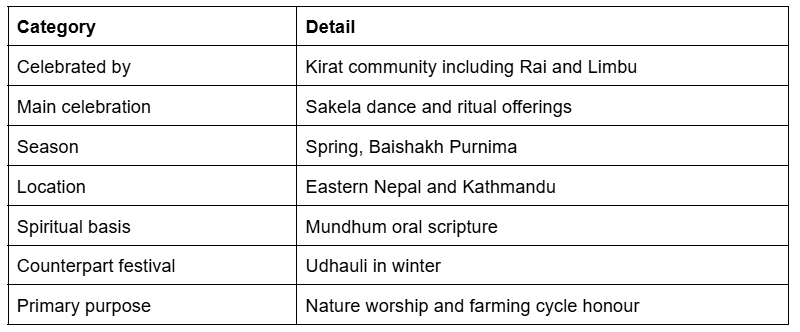
- Celebrated by: The Kirat community, including Rai, Limbu, and related indigenous groups
- When: Baishakh Purnima, the full moon of April and May
- Main ritual: Sakela dance performed in circular groups
- Purpose: Honoring nature, ancestors, and the agricultural cycle
- Where: Eastern Nepal and publicly in Kathmandu
Everything else, the deeper meaning, the dance, the culture behind all of it, and what it is actually like to be there, is covered below.
Quick Facts About Ubhauli Festival
What Is the Ubhauli Festival? Understanding the Basics
If you go in expecting something like a cultural fair or a performance event, Ubhauli will catch you off guard, and in the best way. This is not a festival in the loose, modern sense of that word. It is a seasonal marker, a religious ceremony, a community reunion, and an agricultural ritual, all happening at once, all folded into each other.
For the Kirat people, there is no clean line separating daily life from nature, from farming, from spiritual practice. It is one continuous thing. Ubhauli lands at a specific, meaningful point in that continuum. It is the moment when communities begin the upward journey with their animals toward the alpine pastures while simultaneously preparing the home fields for the growing season. Marking that moment with dance, ritual, and communal gathering is not tradition for tradition's sake. It reflects a genuine understanding that some things deserve real ceremony.
Ubhauli Meaning and Cultural Origin
The word itself comes from a Nepali root meaning upward movement, going up. In practical terms, that is exactly what it describes: herders and their animals heading toward higher elevation as winter loosens its hold and the upper pastures open up again.
But the specific way the Kirat communities have ritualised this movement over centuries is entirely their own. The roots of Ubhauli stretch back further than any written record of the region. The Mundhum, the sacred oral scripture of the Kirat people, provides the philosophical backbone that connects the festival to ancestor veneration and a deep, lived reverence for the natural world.
The agricultural side of things matters just as much. As communities move animals upward, they are also beginning to prepare the lower fields for rice and other crops. Baishakh Purnima sits right at the intersection of both activities, and the celebration honours that intersection honestly, not symbolically.
Who Are the Kirat People? Understanding the Community Behind Ubhauli
You cannot really understand Ubhauli without understanding something about the Kirat people first. The festival only makes full sense inside the cultural world that produced it.
The Kirat are among the oldest indigenous peoples of the Himalayan region. Their history in what is now eastern Nepal predates the major empires and kingdoms of the subcontinent by thousands of years. Ancient Hindu texts, including the Mahabharata, reference the Kirat as a distinct and formidable mountain people, and scholars of South Asian history consistently place them among the region's most ancient continuous communities.
Today the Kirat community includes several distinct ethnic groups: the Rai, Limbu, Sunuwar, and Yakkha peoples. Each has its own language and specific cultural traditions, but they share the broader Kirat identity and the Mundhum-based spiritual framework that shapes their worldview. In Nepal's current ethnic classification system, these groups maintain their distinct identities while also being recognised as part of the wider Kirat heritage.
The Kirat Belief System: Mundhum and Nature Worship
The spiritual foundation of Kirat culture is the Mundhum, an ancient oral tradition that holds the community's cosmological, ethical, historical, and ritual knowledge. It is not a written scripture in any conventional sense. It is a living, breathing oral tradition kept alive by religious specialists called Nakchong or Bijuwa, who memorise, interpret, and pass on its contents from one generation to the next.
The Mundhum's relationship with nature is not incidental; it is fundamental. The Kirat worldview places human beings within nature rather than above it. The rituals of Ubhauli and its winter counterpart Udhauli reflect this directly. The earth, the rivers, the forests, the turning of the seasons, and the spirits of ancestors who have returned to the natural world are all living presences within the Mundhum framework. The festival rituals address all of them, specifically and intentionally.
Sakela Festival and Dance: The Heart of Ubhauli
The Sakela dance is the most visible and iconic part of the Ubhauli celebration. It is usually what travelers encounter first, whether they stumble across it in Kathmandu or seek it out in the eastern hill towns where the Kirat community is rooted.
What Is the Sakela Dance?
Sakela is a group circle dance performed during Ubhauli and Udhauli by community members of all ages and genders. A Nakchong leads the opening ritual, establishing the spiritual context for everything that follows before the wider community joins in.
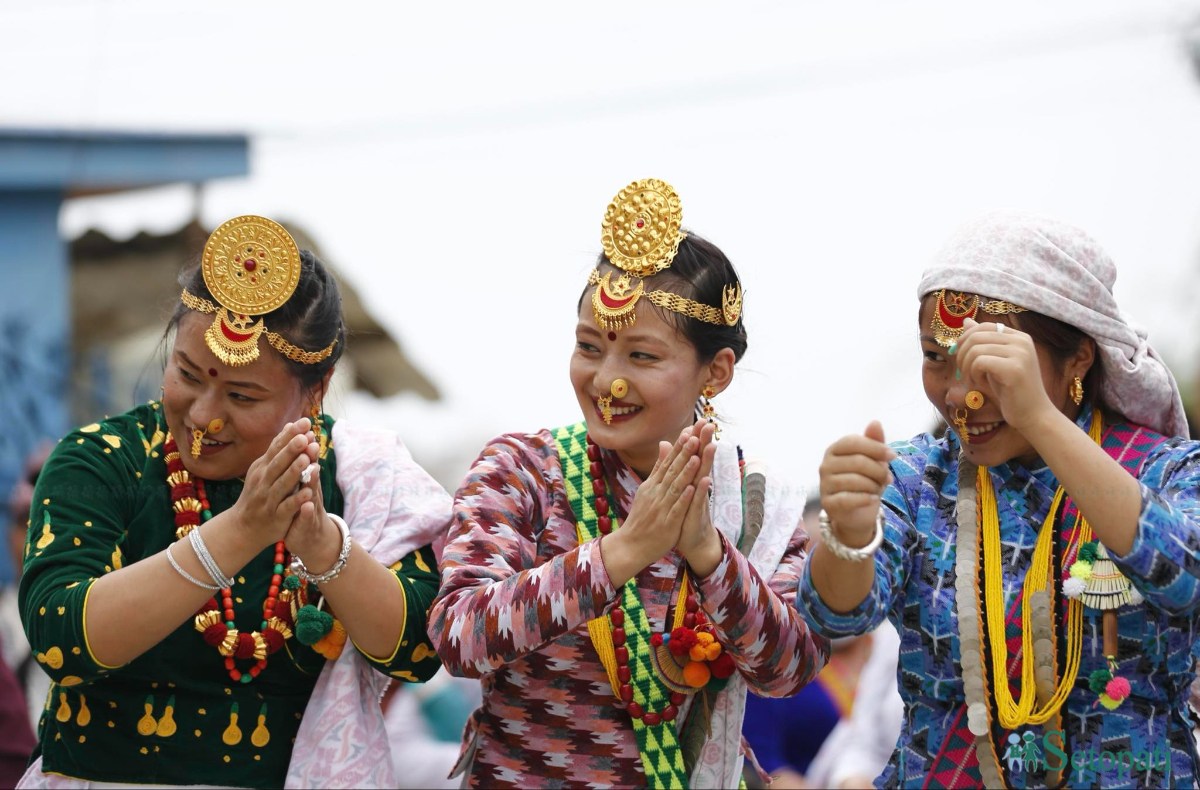
The movements are not random or decorative. Every gesture and sequence of steps represents something specific drawn from the community's relationship with nature, agriculture, and daily life. Some movements represent sowing seeds. Others mimic the flight of birds, the gait of animals, or the physical actions of farming and gathering. In this sense, Sakela is a living archive, encoding practical and spiritual knowledge in physical form and transmitting it across generations without ever writing a single word.
The Music Behind the Dance
Sakela is performed to the rhythm of traditional drums called Dhol and Jhyamta, alongside chanting that often draws directly from Mundhum verses. The rhythmic structure is genuinely complex. Community members who have been dancing Sakela since childhood move with a fluency that takes years to develop and is immediately recognisable to anyone watching closely.
People who see Sakela for the first time often describe something they did not expect: the combined effect of the drums, the chanting, and the circular movement of dozens of dancers together does something to you. It is hard to explain and photographs do not capture it.
The traditional attire adds another dimension. Women wear the Cholo and Patuka in traditional Rai and Limbu designs with distinctive jewelry including Dhungri earrings and necklaces that carry community identity. Men wear traditional garments with khukhuri knives at the belt, markers of both cultural identity and historical warrior tradition.
Ubhauli Festival Rituals and Traditions in Detail
The ritual structure of Ubhauli begins before the dancing. The Nakchong performs ceremonies that call on ancestral spirits and make offerings to nature and the earth. These opening rituals involve preparing specific foods and placing offerings at a sacred location called the Sakela Than, which serves as the ritual centre of the celebration in each community.
The offerings typically include rice, flowers, local fruits, and items tied to the agricultural season just beginning. The invocations address both specific ancestral spirits and the broader natural forces that the Mundhum identifies as relevant to this time of year. For participants who have grown up within the Mundhum framework, none of this is ceremonial in the sense of being empty. These rituals carry genuine spiritual weight and the community's care in performing them correctly reflects exactly that.
The gathering itself is also a ritual, even if it does not look like one from the outside. Extended families and community networks scattered across different towns and cities throughout the year come back together for Ubhauli. Relationships are maintained, identities are reinforced, and traditions are passed to younger generations who may be growing up far from the ancestral villages where these practices first took root.
Ubhauli vs Udhauli: The Two Festivals That Frame the Year
Understanding Ubhauli fully means understanding its counterpart, because the two festivals together create a complete seasonal and spiritual structure for the Kirat year.
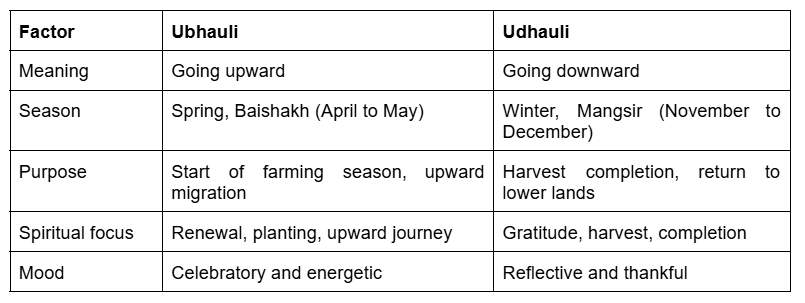
Ubhauli marks the beginning of the active growing season and the movement toward higher land. Udhauli, 6 months later, marks the return, the harvest, and the close of the cycle. Together, they give the Kirat year a rhythm that connects the community's calendar directly to the natural world, a connection hard to find in modern life.
Where Is Ubhauli Celebrated?
The heartland of Ubhauli lies in eastern Nepal, where Kirat communities have lived for millennia. The districts of Khotang, Bhojpur, Solukhumbu, Sankhuwasabha, Taplejung, Ilam, and the surrounding eastern hill districts are where the celebration runs deepest.
In recent decades, as more Kirat community members have moved to Kathmandu for work and education, significant Ubhauli celebrations have also taken root in the capital. Open grounds and parks in Kathmandu now host large public Sakela gatherings during Baishakh Purnima that draw both community members keeping their cultural connection alive and curious visitors who wander in without knowing what they are about to witness.
For travelers who want the most complete and immersive experience, the eastern hill towns are in a different category entirely. Village celebrations in the Rai and Limbu heartland districts include the full ritual complexity: the Nakchong ceremonies, the Sakela Than preparations, and the depth of community gathering that urban events can only approximate. Both are real, but they are not the same thing.
Experiencing Ubhauli as a Visitor
Ubhauli is genuinely welcoming to respectful visitors. Attending a Sakela dance during Ubhauli is one of the most honestly immersive cultural experiences available in Nepal, well outside the usual tourist festival circuit.
The Kathmandu celebrations are the most accessible starting point for most international visitors. Watching hundreds of community members in traditional attire moving in coordinated circles to the sound of traditional drums is something that sticks with you. It is the kind of thing that makes you put your camera down after a while and just watch.
For visitors who want to go deeper, connecting with a local guide from the Rai or Limbu community during the Ubhauli period opens doors to the village-level celebrations and the ritual dimensions that public Kathmandu events do not fully include. That kind of access requires genuine respect, appropriate behaviour, and the willingness to participate humbly rather than observe from behind the comfortable distance of tourist detachment.
Photography is generally welcome at Sakela dance celebrations, but asking for permission before photographing specific individuals, particularly elders and ritual specialists, is important. It is a basic show of respect toward people who are sharing something genuinely sacred.
Common Misunderstandings About Ubhauli
Ubhauli is often described in tourist content simply as a dance festival, which does it a real disservice. The Sakela dance is the most visible part of the celebration but it is the expression of something much deeper, not the thing itself. Calling Ubhauli a dance festival is a bit like describing a religious service as a singing event. Technically accurate about one element, completely wrong about what is actually happening.
The festival also sometimes gets framed as an authentic village tradition that has been watered down in its Kathmandu form. That is not quite right either. The urban celebrations differ from the village originals in some ways, yes, but the Kirat community members who organise and attend the Kathmandu Sakela gatherings bring genuine cultural investment and authentic spiritual intention. Both versions are real.
And Ubhauli is not the exclusive celebration of a single ethnic group. While the Rai and Limbu communities are the most visible celebrants, the festival and the Sakela tradition span the broader Kirat identity, which includes Sunuwar, Yakkha, and related groups. Its significance runs across the whole community.
Cultural Significance: Why Ubhauli Matters Beyond the Festival Itself
In contemporary Nepal, Ubhauli carries weight that extends well beyond its ritual and agricultural functions. It sits inside the country's broader conversations about indigenous identity, cultural preservation, and the rights of ethnic communities within a diverse national context.
Nepal's indigenous communities have faced real pressure on their cultural practices, languages, and traditions through centuries of political centralisation and the dominance of hill Brahmin and Chhetri cultural norms in public life and governance. Ubhauli and the Sakela tradition represent an ongoing, living assertion of Kirat cultural identity that has survived that pressure and continues to be passed to new generations.
The ecological dimension is also worth taking seriously. The festival's orientation toward nature worship and its grounding in seasonal agricultural rhythms represent a traditional ecological knowledge system that researchers and environmentalists are paying increasing attention to. Mundhum's framework, which places humans as participants in nature rather than its masters, has obvious and non-trivial relevance to conversations about how we relate to the environment.
Conclusion
Ubhauli is not something you can fully understand from the outside looking in, and that is honestly part of what makes it worth seeking out. It is not a performance put on for visitors or a tradition kept alive out of obligation. It is a community that, year after year, actively chooses to stop and acknowledge the turning of the seasons, the generosity of the earth, and the people who came before them. That kind of intentionality is rare.
Whether you catch a glimpse of the Sakela dance in Kathmandu or make the trip out to the eastern hills where the celebrations run deeper, what you are witnessing is something genuinely alive. The drums, the movement, the offerings at the Sakela Than, the families gathered together after months apart, none of it is separate from the other. It is all one thing.
For travelers, Ubhauli is one of those experiences that tends to quietly rearrange your sense of what a festival can be. For the Kirat community, it is simply what the season calls for. And there is something quietly profound about a people who have held onto that understanding for as long as anyone can remember.
Frequently Asked Questions (FAQs)
Q. What is the Ubhauli festival in Nepal?
Ubhauli is a major Kirat community festival marking the seasonal upward migration to higher pastures and the start of the farming season. It is observed through the Sakela dance, nature worship, ancestral rituals, and community gatherings on the full moon of Baishakh in April and May.
Q. Why do Kirat people celebrate Ubhauli?
The Kirat community celebrates Ubhauli to honour the natural seasonal cycle, give thanks to ancestors and the earth, mark the beginning of the agricultural year, and reinforce the cultural identity and community bonds that the Mundhum tradition is built around. It is spiritual, agricultural, and social all at once.
Q. What is the difference between Ubhauli and Udhauli?
Ubhauli celebrates the upward movement in spring at the start of the farming season. Udhauli celebrates the downward return in winter at the close of the harvest. Together, they form the two anchoring points of the Kirat agricultural and spiritual year: one marking beginnings, the other completion and gratitude.
Q. Where can I see Sakela dance?
Sakela dance during Ubhauli can be seen in open grounds across Kathmandu during Baishakh Purnima celebrations. The most culturally complete versions are found in the eastern hill districts, including Khotang, Bhojpur, Taplejung, and Ilam, where village-level celebrations include the full ritual context that urban events can only partially replicate.
Q. Is Ubhauli only celebrated by one ethnic group?
No. While the Rai and Limbu communities are the primary and most visible celebrants, Ubhauli and the Sakela tradition span the broader Kirat identity that includes Sunuwar, Yakkha, and related groups. The festival's grounding in the Mundhum spiritual framework gives it significance across the entire Kirat community.